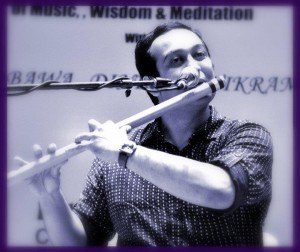
them. Wanted to share this one in particular from an old friend called
Sagar, whose family has been instrumental in bringing AOL to New
Barrackpore, a suburb of Kolkata.
I feel we shd hv more such stories every now and then to stimulate the
intellect and deepen our spiritual experience. What say?
Jgd
V
Sent from my iPhone
>
>
> Dear Vikramda,
>
> My regards for choosing to open discussion on such a great subject.
> Here's my take on the topic (it's a dare given the fact that this is
> something that you also are struggling to figure). This reply is ju
> st merely my effort to unravel the story and I request you to correc
> t me and show me the way to understand the story better. Thanks agai
> n for sharing this story with us.
>
> (1) The Master is the Self personified. He is the window to the
> reality. Though he does speak, words fail to carry the greatest of
> the truth as the 'word' is also a vehicle, a component of this
> ever-changing flimsy existence. What remains of this ever-emerging a
> nd ever-perishing world is an innate experience of the substratum. T
> hus the real communication is in silence which is the truth itself.
> [Recalling the great quote "sach hain to sirf Guru ka maun"]
>
> That's why Patanjaali had to impart knowledge only through silence a
> s that is how the experiential truth can be shared.
>
> (2) The veil signifies the limit of the worldly existence. As Sri
> Ramakrishna Paramahansa shares in a commentary with his disciples in
> Sri Ramakrishna Kathamrita, wherein he held his linen towel (gamcha)
> in front of his face and said 'See, can you see me?' and then
> removed it to show his face. Then he said, 'This is Mahamaya. Pray t
> o her continuously so that she removes this web of unreal which cove
> rs the Real. With her grace only can we see the truth.'
>
> All our wisdom and knowledge reaches zenith at a point where we are
> just separated from the true Self by our body because beyond that is
> the realm of Adwaita, the truth. The Master is the knowledge because
> when he imparts those experiential truth to his students, he is
> sharing the fact that there is no second, all this and all that are
> the same. The intent disciple and the master merges into the same.
> The veil will thus remain as it denotes the limits to our existence
> in this body. As the shastras say, it will just erode from a thick
> fortress wall to a line drawn on water but it will stay.
>
> The burning down of the students signifies the merge, the meltdown
> because beyond the veil where is the master and where are the
> students. All is one and One is all. If the veil of worldly
> existence is removed, where is the world? So when the most curious
> disciple dared to move the curtain, where is he and the others? All
> he would find that "Sarvam Brahm Mayam". Each and every atom is
> the manifestation of the same energy.
>
> (3) Why was the one boy forgiven? Why would he be not! The Master is
> compassion personified. This, I think, also signifies the fact that
> the Divine has left ways for this wonderful knowledge to remain
> within reach of us mortals. However disastrous maybe the scope of
> affairs, there always remains a way in this worldly drama for the
> ultimate truth to manifest in some name and form. Had the boy not
> been there, how would the lineage of the magnificent knowledge from
> Patanjaali continue to thrive?
>
> Also it signifies that a disciple with a good intent, care and
> reverence for the Master and the ability to cling to truth at the
> most precarious of situations would be given the knowledge. He may
> have to suffer from the laws of this world (as he did as a
> BrahmaRakshash) but for everybody and every being the path to ascent
> and exit will be opened in time.
>
> (4) The goat is most likely the manifestation of ignorance. Is it
> not true that when covered by the dark veil of ignorance, the
> greatest of the knowledge given is also treated with least
> importance and ignored? Here lying was the Patanjaali sutras, the
> godsent remedy to worldly maladies, somehow saved from the brink of
> extinction by repeated intervention by the Divine but to a goat it
> was no more than a few juicy palm leaves and food for the stomach.
>
> This signifies that the knowledge is different shapes and form is
> everywhere in this world but to the ignorant it will not be
> revealed. Though the greatest of the truth can always be seen by the
> Master everywhere, the seeker or the disciple can see it at times
> through Master's Grace whereas the ignorant will be never be able to
> find or see it anywhere because even if he assimilates the greatest
> of these knowledge, it will never appear to him as an experience an
> d hence will remain a 'concept'.
>
> (5) The significance of the story:
>
> The Master is the Reality, the Divine. Our journey to become humans
> and have this ability to perceive wisdom and use logic is proof
> enough of the benevolence of the Divine that He wishes us to know
> the truth behind this drama.
>
> Whenever the truth will be shrouded the Divine will emerge as the
> Master and will take us to the zenith of the wisdom. Few of us will
> wonder beyond the veil to know that 'No Two' is what remains. We
> are the same substance and the being which is the smallest atom and
> the largest star. The same Being which propagates the universe is al
> so the meekest of the insects trodden under an unintentional footstep.
>
> The other significant gesture the story makes is that the whole of
> the knowledge is not available for us to perceive in this form. The
> little forgiven boy was given the 'rest' of the Patanjaali
> sutras. Of that when Patanjaali himself came and wrote them down, so
> me of it was eaten by the goat and the rest was carried for propagat
> ion. Here comes the 'wonder' factor which Guruji reiterates time
> and again. The fact that one knows the part allows him to
> 'wonder' about the Whole!
>
> Sri Ramakrishna always used to ask his Brahma disciples not to
> illustrate the magnitude of the entire universe and its existence
> for the purpose of inducing devotion. He always claimed that we are
> ants standing in front of mountains of sugar grains. How can we even
> measure what the full is! The only tool for us is amazing 'I
> don't know!' uttered in wonder.
>
> The other very important strain from the story is the fact that it
> reiterates the compassion of the Master. Consistently the Master,
> who is Divine personified, showers compassion on his disciples -
> right from gathering them, imparting knowledge, forgiving them,
> coming back to save them suffering from the claws of worldly laws
> and finally drawing on his own blood to write the sutras. Where is
> the knowledge without the Master! But for that we would all be goats
> chewing on tasty palm leaves.
>
> Lastly the story signifies that all these happen in worldcycles or
> Kalpas. The knowledge is there and it is going to stay. But from
> time to time the Masters will come to impart it to us and by their
> grace some of us will move out of this endless cycle of worldly
> laws. For others, the Master will strive to reach out the farthest
> and many will move ahead. But to the Master, none of these matters
> as he is ever sure of his presence and knows that in time, each one
> of us will move to perfection in some worldcycle or other.
>
> Jai Gurudev!
>
> Drop a line if you wish..........
>
> Love and regards,
>
> Sagar Bhattacharya


